Real Estate vs Stocks – Analyzing the Benefits of Investing in Real Estate
June 27, 2018 In this blog post I compare the two most popular investment avenues – real estate and stocks. We adopt a data driven approach in order to give some great insights that you will help you make better investing decisions.
Real Estate vs Stocks – How to Make Data Driven and Better Investing Decisions
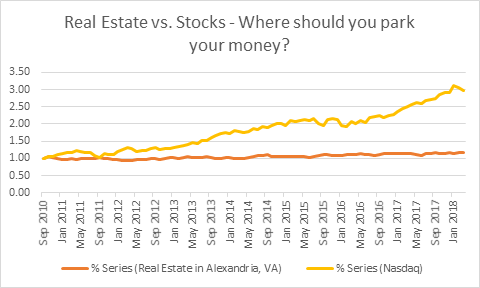
Wondering where to park your funds? Real estate vs stocks? Oscillating between these two alternatives? Analyzing historical data is a great way of making data driven decisions. In order to determine the better investing avenue, I charted median sale prices for single family homes in Alexandria, VA from Sep 2010 – March 2018. I plotted this data alongside NASDAQ movement in the same period. These stats throw light on some interesting facts –
In absolute terms, a dollar invested in a single family home in Alexandria, VA in Sep 2010 grew to $1.18 by March 2018
Whereas, if you had invested a dollar in NASDAQ companies, your investment would have grown to…$2.98! That is 2.5 times the return yielded by investing money in Alexandria real estate.
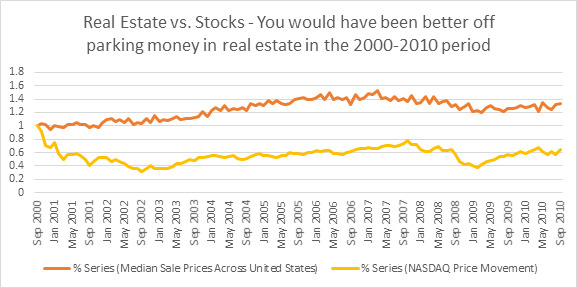
Wait! Fefore jumping to any conclusions on this real estate vs stocks topic, let us dive deeper into the data. I decided to look at NASDAQ price movement in the preceding 10 year period (Sep 2000-Sep 2010). And the results, well, were dramatically different. A dollar invested in NASDAQ in Sep 2000 would have turned to….64 cents by Sep 2010! A whopping drop of 43%! In the same time period, median house prices across United States showed an increase. A dollar invested turned to a $1.32 in the same time period.
So, some takeaway after analyzing this data –
- Black Swan events such as the Dot Com crash and the Lehman crisis of 2008 have a far greater effect on your stock portfolio. Your real estate investment is more resilient to such outliers.
- So, if you had invested in the stock market after the dot com crash in 2000, your investments in NASDAQ stocks would have plummeted by 78% from September 2000 – September 2001. Median houses prices decreased by just 2% in the same period.
- The collapse of Lehman brothers resulted in NASDAQ plummeting 41% in three months. And, real estate prices in fact increased by 1% in the same time frame.
- NASDAQ movement was far more volatile – November 2000 saw NASDAQ dip by 23%. Whereas the largest dip in real estate prices was 9%.
- How long should you hold your investment? Frankly, forever. Or at least, as long as you can. Doing so will enable you to ride out the troughs.
How Leveraging can yield handsome margins in real estate investing
One of the biggest advantages of investing in real estate is your ability to leverage. If you have a credit score greater than 720 and a debt to income ratio which is less than 36%, your chances of getting a home loan at the lowest mortgage rates are extremely good. In a hot real estate market, when house prices are on the upswing, leveraging can help you generate extremely handsome returns. How so?
Let us presume that you are purchasing a $500,000 house in Alexandria, VA. In order to purchase this house, you will need 20% towards the down payment and 5% to cover your closing costs. So, if you need $125,000 in order to purchase this $500,000 property. Let us presume that over the next 5 years, the property appreciates at an annual rate of 5%. This means that the value of your property will grow to $638,140 at the end of Year 5.
Remember – You were able to achieve this appreciation by simply investing $125,000. That is the power of leveraging.
You will also have to factor in your borrowing expenses and the rental yield in order to determine the feasibility of your investment. Let us consider a mortgage rate of 4.5% and a rental yield of 5%. Interest payments and rental yields are as follows –
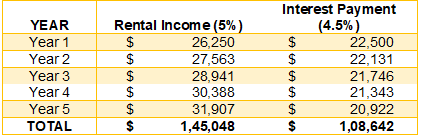
Assuming a rental yield of 5%, total rental income generated over 5 years will be $145,048. Interest payments over these 5 years amount to $108,642. Did you notice how your rental income is increasing YOY while your interest payment is decreasing YOY? The increase in your rental income is in line with the 5% YOY increase in property prices. Whereas, you need to understand the nuances of loan amortization to understand why your interest payments are decreasing YOY. Remember – as the equity in your home increases, your interest payments will show a decrease.
Let us look at your final financial scorecard at the end of 5 years:
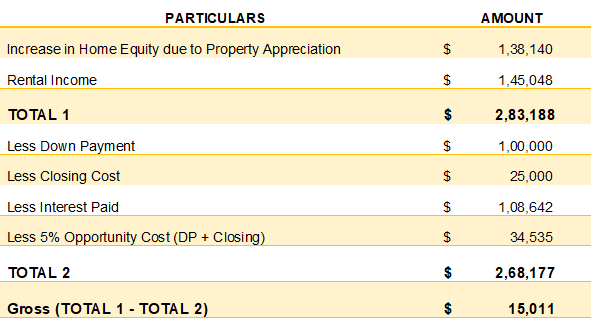
Thus an investment of $125,000 generated a return of $15,011 over 5 years. This works out to be an annualized return of 2.5%. Now, if your property appreciation was greater or your rental yield was higher, the picture will be really different.
For instance, Zip Code 22309 in Alexandria, VA witnessed a 23% increase in property prices from Jul 16 – Jul 17. Likewise, Richmond Country in VA has one of the highest rental yields in the country (greater than 20%). Let us explore these more aggressive scenarios. Using a rental yield of 7.5%, let us conduct a sensitivity analysis for 3 scenarios with annual property appreciation of 7.5%, 10% and 15%.
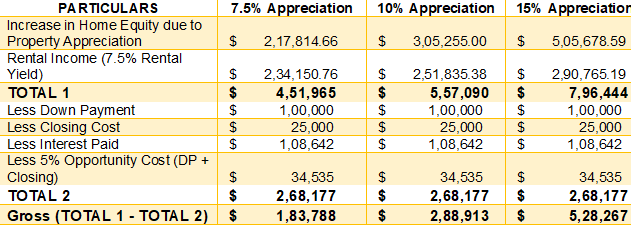
As you can see from the table above, your returns go through the roof. Higher Property Appreciation, Higher Yields and the magic of compounding sends your returns soaring. A 7.5% annual property appreciation and a 7.5% rental yield means that you can pocket a gross profit of $183,788. And this is on an initial investment of $125,000. That is an annualized return of 19.5%!
A word of caution here – Leveraging can have a reverse effect in a slow market where property prices go downwards.
Real Estate vs Stocks – Some more benefits of investing in real estate
So, we have talked about the two biggest benefits of investing in real estate – less volatility and leveraging. Let us talk a bit about some more benefits
Insulated and local economy – Real estate prices are dependent on local economic factors. And while national occurrences such as mortgage rate fluctuations are important, your real estate investment is “insulated” in a lot of ways. For instance, with the auto sector heading south, there aren’t many takers for real estate in Michigan. But, Virginia, with its booming industries, remains a great place to invest. Have a reliable and knowledgeable real estate agent conduct a thorough CMA (Comparative Market Analysis) in order to determine the Pros and Cons of investing in your area.
Tax breaks – Uncle Sam is doing his bit to make your real estate purchase more affordable. Take advantage of the various property tax deductions to lower your ownership cost. Annual mortgage deductions can save a lot of moolah. Because of property tax deductions, real estate investing is particularly attractive for those in the higher tax bracket.
Easier to analyze – Compare to stocks, real estate is easier to analyze. Historical data is easily available from sites such as Zillow and Redfin. Using this data, it is easy to kick start your research in order to zero in on an appropriate and promising investment in your area. If you want to do a deep dive, it is advisable to avail some expert help.
Want Greater Returns? – If you have a greater risk for appetite and the financial strength to back it up, you should strongly consider foreclosures, fixer/uppers or all cash purchases. Make sure to follow a systematic, step-by-step investing approach or you will end up getting saddled with a poor property.
Conclusion
Reduced volatility and an ability to leverage makes real estate investing an attractive alternative for many. If you are uneasy with the uncertain nature of stock market, we strongly recommend you consider parking your funds in real estate. Proper research and expert guidance can help you zero in on foreclosure homes and fixer uppers – the perfect low risk, high return investment.